
Sampson County Probate Venue
North Carolina does not use a separate county probate court for Sampson County. Probate of wills, administration of estates, and related estate supervision are handled by the Sampson County Clerk of Superior Court. The Judicial Branch describes clerks of Superior Court as officials who exercise judicial power in probate of wills and administration of estates. That means estate filings are court records, but the day-to-day counter, copy, and file-review path runs through the clerk's office.
The clerk's estates role is different from the Sampson County Register of Deeds. The Register of Deeds handles marriage licenses, marriage certificates, birth and death certificates, deeds, plats, assumed names, and many other non-court records. Estate files, original wills filed for probate, inventories, accountings, letters testamentary, and special proceedings belong with the Clerk of Superior Court. A reader looking for a death certificate may need the Register of Deeds or state vital records; a reader looking for an estate file should start with the clerk.
The N.C. Judicial Branch estates help topic explains the probate process at the state level, including how probate can mean both estate administration generally and the specific act of deciding whether a will is valid. Sampson County follows that North Carolina framework because its trial court work is part of the unified General Court of Justice.
The Judicial Branch estates page is the official statewide reference for Sampson County probate records and estate administration basics.
Use that source for the general estate process, then use the Sampson County clerk for the local file, copy, and appointment path.
Sampson County Estates Contact
Estate questions should be routed to the courthouse contact listed for the Sampson County Clerk of Superior Court. The clerk can confirm whether an estate file exists, whether a will has been probated, what copy options are available, and whether a document must be reviewed in person. The same courthouse contact is also the best starting point for special proceedings that overlap with estates, such as certain guardianship or property matters.
Sampson County Clerk of Superior Court
Estates Division / clerk estates jurisdiction
101 E. Main St
Clinton, NC 28328
(910) 596-6600
Monday-Friday, 8:30 AM-5:00 PM
The courthouse page also lists wheelchair access and elevators. A person visiting for probate records should use the case file, notice, or clerk instructions to confirm whether the main courthouse, annex, or extension is the correct place for a hearing or filing.
Sampson County Probate Terms
Estate files use terms that are easy to confuse. These definitions reflect the way North Carolina estate records are commonly described in Judicial Branch materials and clerk practice.
- Testator
- The person who made a will before death.
- Executor
- The person named in a will to carry out estate duties after appointment by the clerk.
- Administrator
- The person appointed when there is no valid will or no named executor able to serve.
- Intestate
- Dying without a valid will, which usually leads to administration under North Carolina intestacy rules.
- Letters
- The clerk-issued authority, such as letters testamentary or letters of administration, that allows a personal representative to act for the estate.
- Guardianship
- A court-supervised proceeding involving a minor or an adult who may lack legal capacity, often with more restricted access than a routine estate file.
Search Sampson County Probate Records
Online estate case information may appear through NC eCourts Smart Search, but Portal is not a complete substitute for the physical or clerk-held estate file. Use Sampson County as the location filter when possible. If the decedent had a common name, a file date, case number, attorney, or personal representative name can help avoid statewide name collisions. Portal requires JavaScript and cookies, and its public view can be limited by case type, access level, and confidentiality rules.
| Field Label | Type | Required | Options / Format Notes |
|---|---|---|---|
| Portal Smart Search record/name | Text | Yes | Search by estate case number if known or decedent name. |
| Filter by Location | Dropdown | Optional | Select Sampson County to narrow the statewide portal. |
| Case Type | Dropdown | Optional | Use estate, probate, or special proceeding filters if available. |
| File Date Start / End | Date | Optional | Useful for recently opened estates or known filing windows. |
| Party Search | Text | Optional | May include decedent, personal representative, heir, applicant, or attorney name. |
If Portal does not show the document needed, contact the clerk. Certified copies, original wills, accountings, and older estate papers may not be fully visible online. Background-check-style searches and restricted files should also be handled through the clerk rather than treated as complete based only on Portal results.
- Start with the decedent's full name and county of residence or estate venue.
- Search Portal by record number if available, or by name with Sampson County selected.
- Use file-date or case-type filters when the result list is broad.
- Call or visit the Clerk of Superior Court for the full estate file, certified copies, or documents not shown online.
- Use the Register of Deeds only for vital records or recorded land documents tied to the estate.
The decedents' estate procedures pamphlet is the Judicial Branch publication for the forms and duties that often create Sampson County probate records.
That pamphlet helps identify the document names a clerk may ask for when locating or copying an estate record.
Sampson County Estate Documents
A Sampson County probate file can contain more than a will. The contents depend on whether the estate is testate, intestate, small, contested, or tied to another special proceeding. A simple estate may have only the opening application, oath, letters, inventory, notices, accounting, and closing papers. A contested estate may add orders, caveats, motions, hearing notices, and other court filings.
- Application for Probate and Letters
- Application for Letters of Administration
- Original will or codicil
- Death certificate and identity documents
- Oath and resident process agent form when required
- Inventory, annual accounts, final accounts, receipts, releases, and closing documents
Divorce and estate files sometimes intersect when property rights, former spouses, or support obligations affect an estate. The North Carolina divorce packet is not an estate form set, but it is a useful official source when the probate question depends on whether a divorce judgment exists.
When an estate issue depends on a divorce judgment, the Clerk of Superior Court is also the office for copies of divorce judgments entered in Sampson County.
Sampson County Probate Fees
Estate filing costs and copy charges can change. The research file identifies the Judicial Branch Current Court Costs page as the authoritative source for current estates court costs. A local estate guideline referenced in the research mentioned a $120 filing fee for an intestate full estate, but that amount should be confirmed against the current estates court-cost schedule or directly with the clerk before payment.
| Probate cost item | How to confirm current amount |
|---|---|
| Estate opening or probate filing | Use the current Estates Court Costs schedule or call the clerk. |
| Letters testamentary or letters of administration | Confirm with the Clerk of Superior Court before requesting copies. |
| Certified estate copies | Ask the clerk for current per-copy and certification charges. |
| Guardianship or special proceeding costs | Review the current court-cost schedule because the filing type controls. |
| Vital record copies needed for an estate | Use the Register of Deeds or N.C. Vital Records fee source, not the court-cost schedule. |
Current-cost caution: Do not mail cash. Confirm the current filing amount, payee, and accepted payment method with the Clerk of Superior Court or the Judicial Branch court-cost schedule before sending an estate filing.
Restricted Sampson Probate Records
Most routine estate files are public court records unless sealed or restricted by law, but public access does not mean every page will be copied or displayed without review. Social Security numbers, financial account numbers, medical information, and other personal identifiers may be redacted. Guardianship records can involve sensitive incapacity or medical facts, so those files should not be treated like an ordinary inventory or creditor notice.
North Carolina access rules also draw a line between court records and vital records. G.S. 130A-93 governs access to vital records, while G.S. 7A-109 addresses clerk recordkeeping and public inspection of court files unless access is barred by law. A death certificate used in an estate file may therefore be handled differently from the estate docket itself.
G.S. 130A-93 is the state law source for vital record access questions that may arise during a Sampson County probate records request.
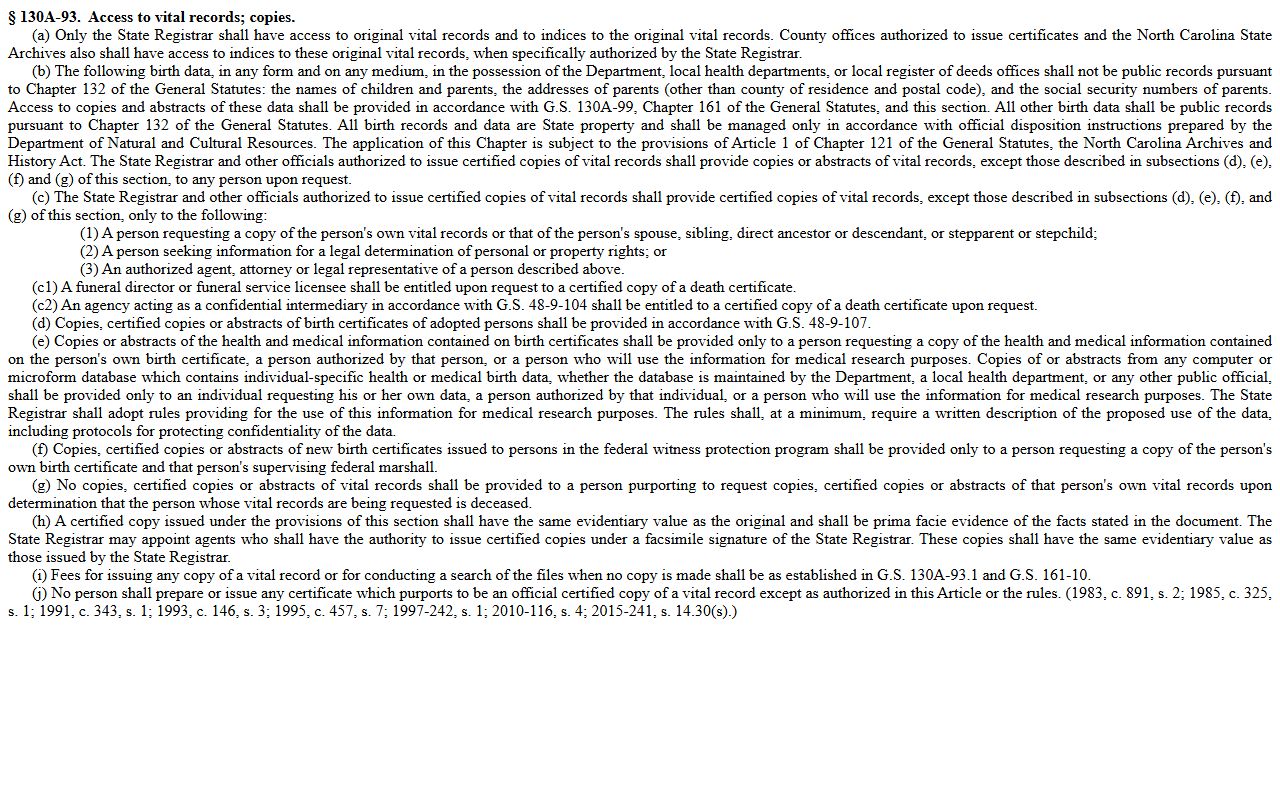
Use that distinction when an estate file mentions birth, death, or marriage records that must be requested from a vital-record custodian.
Note: For certified estate copies, the clerk's seal and certification control, not a printout from an online search result.